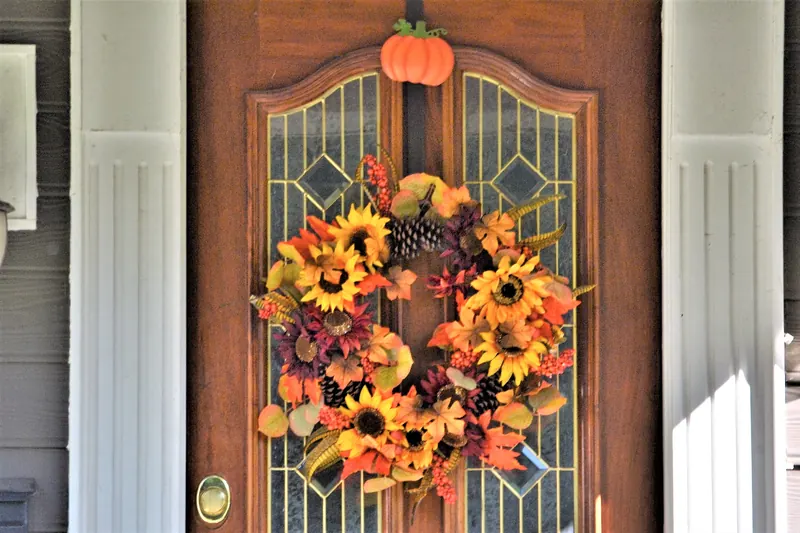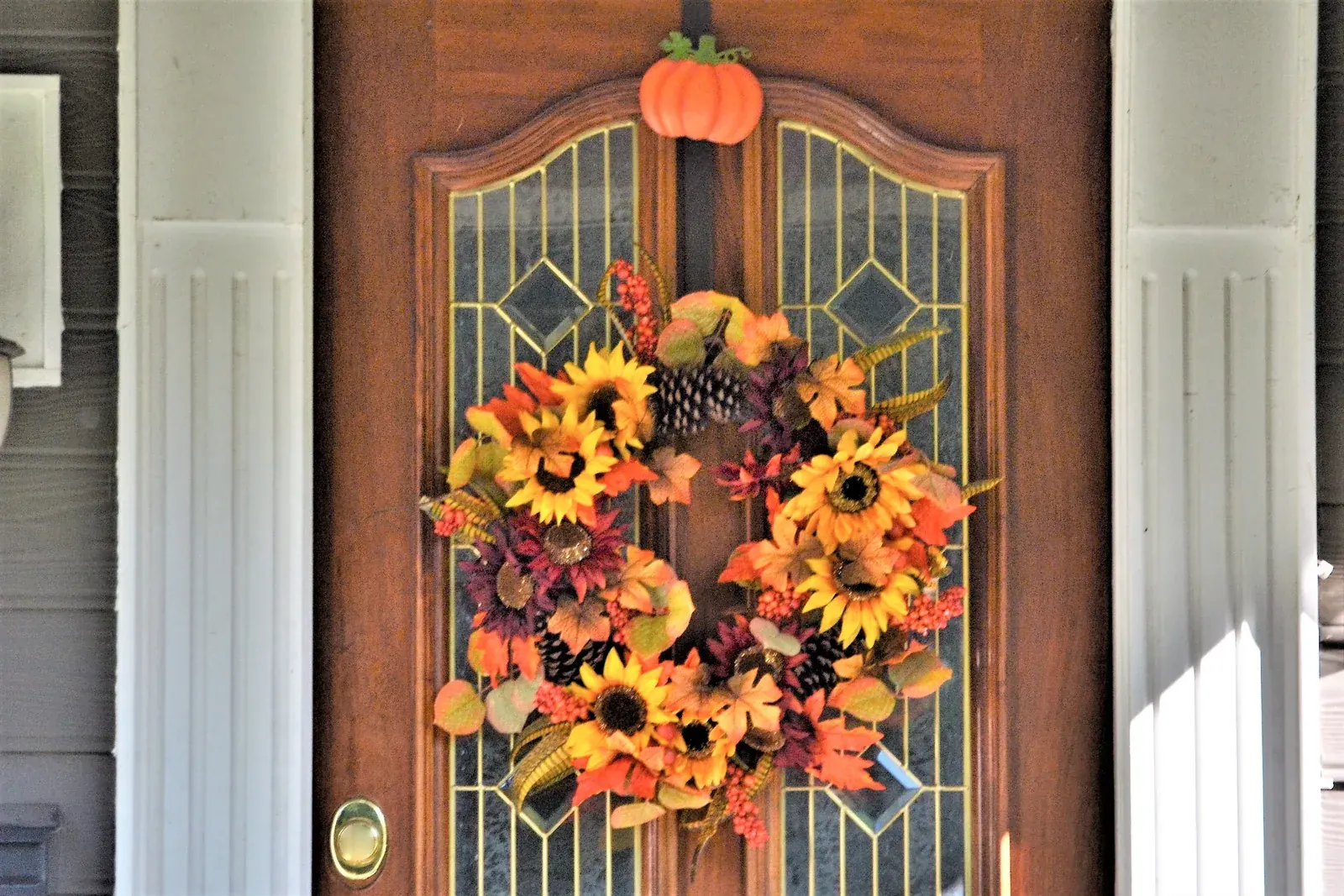
Pinterest has been telling the same wreath story for a decade: “DIY this gorgeous fall wreath for $15!” I believed it once. Then I stood at the Michaels register with a grapevine base, seven stem picks, wire, and ribbon, watched the total land at $41 even with the coupon, spent two hours building it, and produced something so sparse my own front door looked embarrassed for me.
So this article does what the pins will not: the honest math, receipts included. When buying wins (spoiler: your first year), when DIY wins (year two, decisively), the 90-minute build that avoids my sparse-wreath fate, and the sizing rule that fixes the most common wreath mistake in America before you spend a dollar either way.
The Honest Math
The direct answer in one sentence: buying wins the first year, DIY wins every year after, because the base and tools amortize while store prices reset to full every September.
| Option | Real total cost | Time | The rendering |
|---|---|---|---|
| DIY, year one | ~$35–45 (base + stems + wire + ribbon + cutters) | 1.5–2 hrs | As good as your density discipline |
| DIY, year two onward | ~$15–18 (fresh stems only) | ~1 hr | Better; you know the moves now |
| Buy: budget tier | $20–30 (Target, Walmart) | 0 | Good from the curb, thin up close |
| Buy: mid tier | $50–70 (Pottery Barn, Studio McGee at Target) | 0 | Genuinely dense, the safe gift to yourself |
| Buy: artisan | $80–120 (Etsy makers) | 0 | The one that gets asked about |
Prices checked July 2026, and the DIY line is not an estimate: it is my receipt, itemized below in the build section. The $15 DIY wreath exists only if you already own the base, the wire, the cutters, and half the stems, which is another way of saying it exists in year two.
If You Buy: 3 Tiers That Look Good
Under $30
Target and Walmart’s seasonal wreaths are the value floor, and the good ones hide in plain sight. Two checks at the shelf: density (hold it at arm’s length; if you can see through it to your hand, it will read thin on a door) and the base (visible grapevine in gaps is charming, visible foam or plastic is not). Buy early September; the dense ones go first and the picked-over ones are picked over for a reason.
$30–70
The sweet spot for a first wreath you keep five years. Pottery Barn’s faux botanicals and the Studio McGee line at Target lead here: real stem variety, wired branches you can reshape, density that survives close range. At $60, amortized over five autumns, this tier costs $12 a year, which quietly beats everything else on the table.
The Etsy Artisan Route
$80 to $120 on Etsy’s handmade fall wreaths buys a maker’s asymmetry, unusual botanicals (dried grasses, bunny tails, preserved eucalyptus), and the wreath guests ask about. What to check in listings: measured diameter including the stems (makers measure generously), the base material, and photos on an actual door rather than a white wall. This tier is also where you commission the exact Sunbaked tones from the Sunbaked palette if you want the door to match the house.
If You DIY: The 90-Minute Wreath
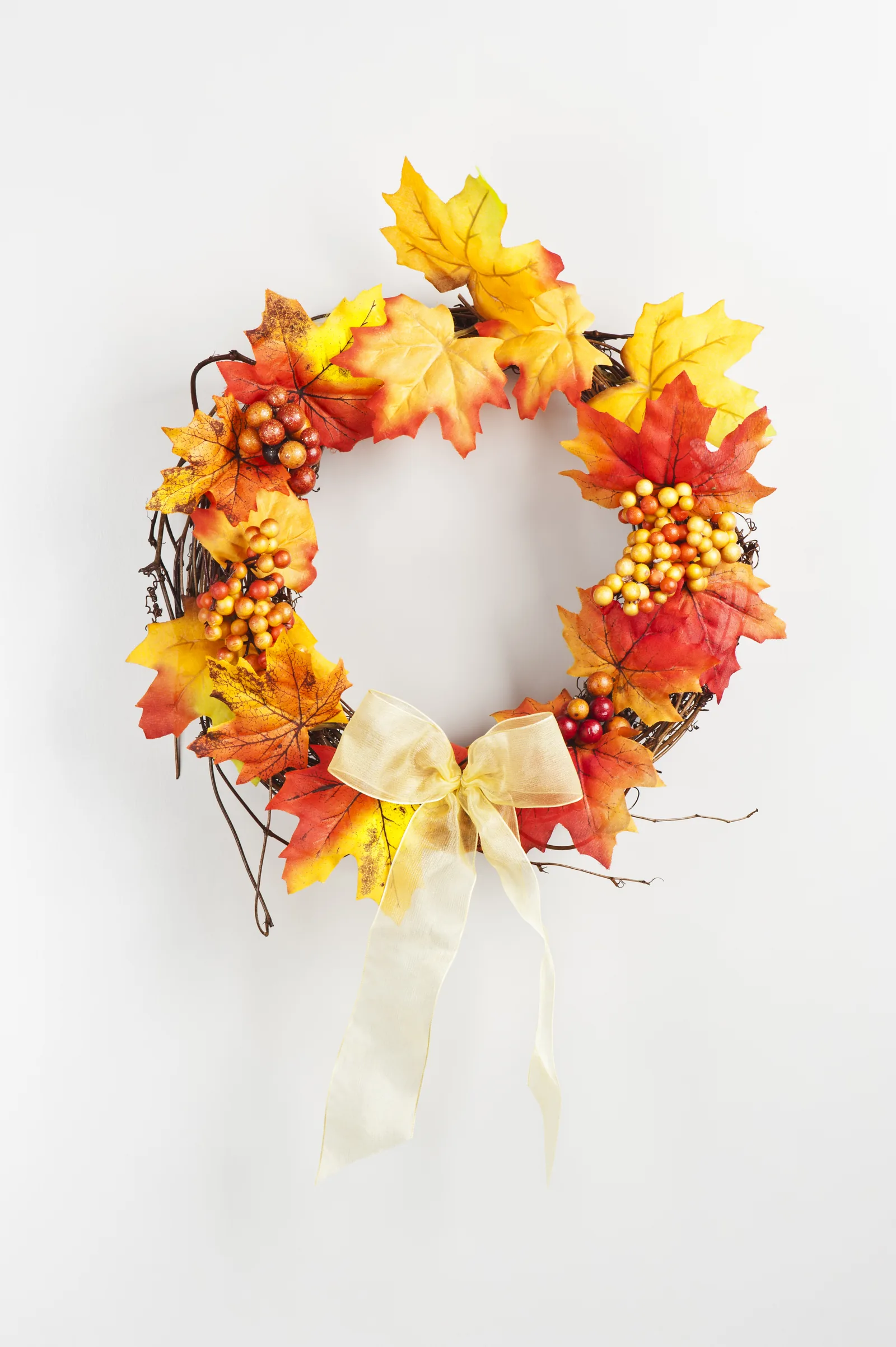
My second attempt, the one that redeemed the first, timed at 1 hour 40 minutes including the coffee break. The supply run, itemized from the receipt (Michaels, with their perpetually available 40 percent coupon applied to the base):
| Supply | Price |
|---|---|
| 18” grapevine base | ~$9 |
| 7 floral stems and picks (wheat, eucalyptus, 2 mini pumpkin picks, berries, 2 filler) | ~$22 |
| Floral wire | ~$3 |
| Wired ribbon | ~$4 |
| Wire cutters (year-one only) | ~$8 |
| Total, year one | ~$46 |
| Total, year two (stems only) | ~$15–18 |
The build:
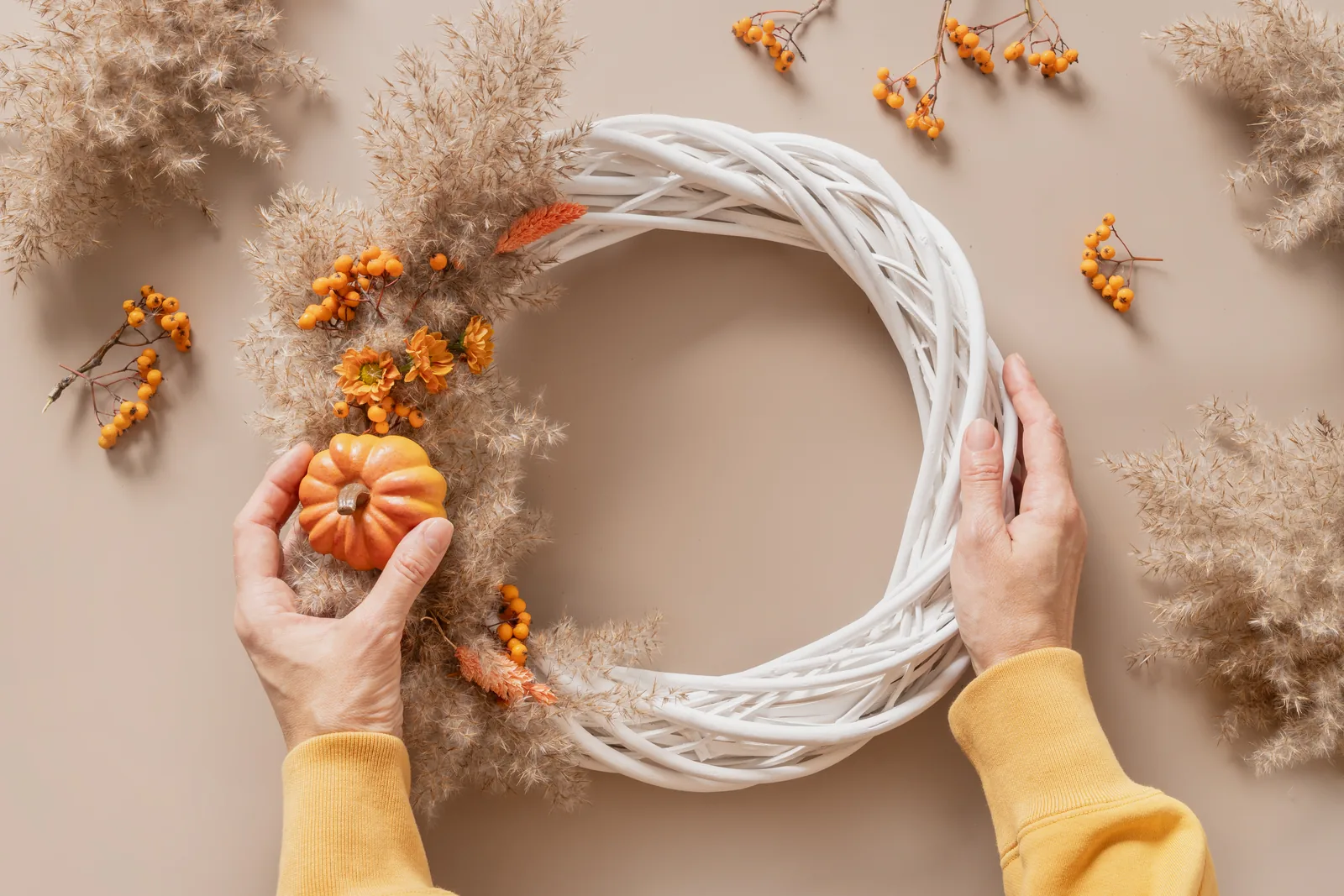
- Lay the bare base on a table and pick its best third; the design lives on one-third of the circle, not all of it. This is the asymmetry move, and it is the difference between homemade and handmade.
- Trim each stem to 6 to 8 inches with the cutters and strip the bottom leaves.
- Tuck the largest stems into the grapevine at an angle, all flowing the same direction, starting from the bottom-left of your chosen third.
- Wire only what wiggles. Grapevine grips most stems on its own; over-wiring is what makes wreaths look trussed.
- Layer in the picks and fillers, stepping back to door distance every few additions. Density check: no daylight through the design zone. My first wreath failed exactly here, six stems trying to do twelve stems’ work; the lesson cost me a sparse October and is the reason this list says seven stems minimum for the one-third design.
- Ribbon last: a simple two-loop bow or a plain streamer tail, wired to the base at the design’s edge, never dead center.


Finishing the Door
The wreath is the focal point, not the whole show. The supporting cast, in priority order:
- Layered doormats: a plain coir or jute base mat with a smaller patterned fall mat on top. The sizes that work: a 24x36 inch base under an 18x30 top. The layer costs about $18 to $30 total at Target and does a third of the door’s work.
- The hanger, without a nail: an over-the-door hanger (~$8) or a magnetic hanger for steel doors (~$12). A finish nail in a painted door is a decision your future self litigates every time she repaints.
- A sign, optional and singular: one vertical “welcome” or seasonal sign leaning by the door if the porch has the width. One. The wreath is already saying it.
- The mums: already covered, cart by cart, in our $25/$75/$150 fall porch.
The Size Rule
A front door wreath should measure about two-thirds the width of the door. Standard American doors run 36 inches wide, which puts the ideal wreath at 22 to 24 inches in full diameter, stems included. The most common wreath mistake in the country is the cute 16-inch wreath floating on a 36-inch door like a lost button; when in doubt, size up, because a wreath that reads slightly generous from the curb reads correct at the door.
Storage (So Year 2 Is Free)
- A hard wreath box or a hanging wreath bag (~$10–15) is the entire preservation system; the crushed-in-a-bin wreath is a year-one wreath forever.
- Store it hanging or flat, never on its edge, in a closet rather than an attic (heat relaxes hot glue and wilts faux botanicals).
- Photograph it before storing; next September’s you will restyle faster from the photo.
- Keep the leftover stems with it. Year two’s $15 refresh starts with what year one did not use.
Mistakes
- The too-small wreath. Two-thirds of the door width, and measure the door, not your memory of it.
- Visible foam base. Grapevine forgives gaps; foam confesses them. Always grapevine.
- Glossy plastic picks. Shine is what separates faux that fools from faux that apologizes. Matte stems only, even at the budget tier.
- Six stems doing twelve stems’ work. My first wreath’s epitaph. Density is the entire game.
- A nail through the door. Eight dollars of over-the-door hardware versus a hole you own forever.
FAQ
Is it cheaper to make your own fall wreath?
Not the first year: a first DIY wreath honestly costs $35 to $45 in base, stems, wire, ribbon, and cutters, roughly matching a good mid-tier store wreath. From year two, DIY wins clearly at $15 to $18 for fresh stems, since the base and tools amortize while store prices reset every fall.
What size wreath should I get for my front door?
About two-thirds the width of the door. For a standard 36-inch American front door, that means a wreath measuring 22 to 24 inches in full diameter, including stems. Undersized wreaths are the most common front-door mistake; when between two sizes, choose the larger.
How do you make a fall wreath look expensive?
Four moves: build or buy dense (no daylight through the design), keep the design asymmetric on one-third of the base rather than evenly all around, use matte stems and picks exclusively, and let visible grapevine serve as the negative space. Density and asymmetry are what artisan wreaths are actually selling.
When should I hang my fall wreath?
Late August to mid-September, alongside the rest of the neutral fall base, and it carries through Thanksgiving under the same 3-Month Rule as the porch. If it is a harvest-toned wreath rather than a Halloween-specific one, there is no reason to take it down before the December swap.
Buy Year One, Build Year Two
That is the math’s honest conclusion, and it is allowed to be both. Take the mid-tier wreath this September, save the receipt envy for next year, and start the stem stash in the January craft-aisle clearance. The door it hangs on is already planned in the fall porch by budget, and when October wants its moodier layer, the wreath stays put while elegant Halloween decor happens around it.
Prices in this guide were checked at publication and are shown as typical ranges. How we check facts and prices →